NETGEAR is aware of a growing number of phone and online scams. To learn how to stay safe click here.
Forum Discussion

Stinky_W_Teats
May 25, 2023Aspirant
Orbi AC3000 generally unhappy
hi, I am struggling with a few issues with wifi on my Orbis: I have six Phorus PR5 receivers (these are hard-wired to an amp which is connected to wired ceiling speakers around the house and al...
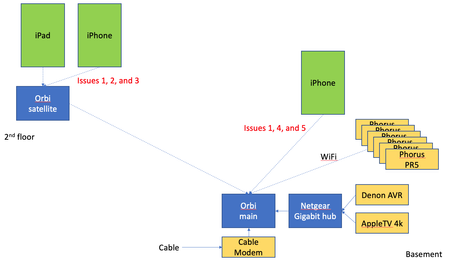
- Jun 14, 2023
Final update: I bought the Nintendo Ethernet adapter (above) for all the PR5s and they have been rock solid since.
Given that the MBP does not always appear in the list of AirPlay devices, plus the iPad issue when connected to the Orbi satellite, plus the drop outs on signal on the Orbis, I will lay the blame on the Orbis, but it is not 100% proven.
Done messing with this, and shame i had to throw money at the issues.

KevinLiT
May 30, 2023NETGEAR Moderator
Hello CrimpOn ,
Thank you for your response!
The ac standard lives entirely in the 5GHz spectrum. While some more modern routers broadcast 802.11n in 5GHz as well as 2.4GHz they remain relatively rare.
Best,
Kevin
Community Team

CrimpOn
May 30, 2023Guru - Experienced User
I still disagree. By supporting 802.11ac on the 5G channel, Orbi routers are also compatible with every previous standard for 5G WiFi, including 802.11a and 802.11n. Yes, 802.11ac makes possible greater speed, but if a device supporting only 802.11n connects, the Orbi will communicate with it at 802.11n. This has been true for every router since 802.11ac was finalized in 2013.
Both the Original Poster (OP) and myself have connected the PR5 to Orbi routers. The Orbi Attached Devices shows they are connected at 5G, and they function. (Orbi does not display which 'flavor' of 802.11 each device is using.)
Phorus probably used 802.11n in the PR5 product because (a) the chip is less costly, and (b) they are receiving audio signals. The amount of bandwidth needed for audio is tiny. There is no need for the greater capacity of 802.11ac.
During the WiFi connection process, both user device and WiFi access point communicate the speeds and features that they support and determine which will be used. It will be an interesting experiment to capture the actual Probe, Association, and Authentication packets for the Pr5 and compare them with those of a product with 802.11ac. (Will take some time to haul out the gear I use to capture WiFi management frames.)
- KevinLiTMay 30, 2023NETGEAR Moderator
Hello CrimpOn ,
"Phorus probably used 802.11n in the PR5 product because (a) the chip is less costly, and (b) they are receiving audio signals. The amount of bandwidth needed for audio is tiny. There is no need for the greater capacity of 802.11ac". This is the most probable reason why it doesn't stay on the 5Ghz network that is optimal with the 802.11 AC protocol. Maybe the best experiment approach will be to probe the PR5 and Orbi communication.
Best,
Kevin
Community Team
- CrimpOnMay 30, 2023Guru - Experienced User
KevinLiT wrote:
it doesn't stay on the 5Ghz network that is optimal with the 802.11 AC protocol.
I believe this is where the OP started the discussion. Attached Devices shows all six PR5 units connected to the Orbi at 5G as well as a MacBookPro at 2.4G. Other devices wishing to use Air Play to send music to one (or more) of the PR5s cannot find them.
If they were disconnecting and reconnecting, then the Orbi log file would show them being assigned IPs over and over.
I agree that investigating the Air Play communications may be a good idea. First step is probably to find a document explaining how Air Play works. My guess is this involves devices sending some kind of broadcasts and other devices responding.
- Stinky_W_TeatsMay 31, 2023Aspirant
hi Kevin, thanks for your input, much appreciated!
Actually, it seems that the PR5s that are connected at 5G are the ones that are visible.
This may not be 100% consistent but since I noticed this seems to be one of the few consistent things around mid-day yesterday, I have checked several times and the only ones that are visible are connected at 5G.
e.g., first thing this morning i saw two PR5s, the one for the master bath ceiling speaker and one for the kids' bath speaker. Checking the Orbi console, both are connected to the main Orbi at 5G.
Now about 2 hours later, i only see the kids' bath and it is the only one connected at 5G.
I think this is validating CrimpOn's point that the various 5G standards are not the issue here.
My theory is that it is the devices switching from 5 to 2.4 that causes them to disappear form the AirPlay list.