NETGEAR is aware of a growing number of phone and online scams. To learn how to stay safe click here.
Forum Discussion

CydTulkas
Dec 04, 2020Aspirant
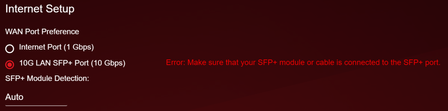
xr700 cannot find Internet through SFP+ port
Hi all, I have recently purchased an XR700 router in the hope of being able to switch the router from the provider. According to my provider I am allowed to use my own router as long as I can con...
BrianKi
Feb 24, 2021Aspirant
Since this seem to be an active forum, I was hoping people who have been down this road ahead of me can answer some stupid questions.
I have an XR 700 router and would like to speed up my network if possible. I was thinking of trying to make use of the 10G feature of the router if I could. I realize that making 10G work will require the upgrading of most of my network components, but let me start with the most basic of questions first.
If I am reading Netgear's manual correctly, it seems like the 10G capability is only via the SFP+ input on the router and that the SFP+ port is supposed to be connected to the cable modem, is that right? The XR700 manual suggests to me that the 10G SFP+ port is an alternative to the standard non-10G RJ45 internet WAN connection. In other words, you use one or the other to connect to the internet, but not both. Also right?
If I am correct about that, how is that possible? I looked quickly and I could not find any 10G cable modems, much less any that had an SFP+ connection. So are there cables that connect with SFP+ on one one end and RJ45 on the other, or do you (should you) use a media converter box and use that as the bridge between the SFP+ port on the router and the RJ45 port on the cable modem? Or is there some other (better) way? And is it even worthwhile going down this road at all given that (as I believe) a 10G cable modem does not exist?
Also, I am a Comcast /Xfinity subscriber, if that makes any difference.
One last set of questions:
I have a separate 10G capable Netgear switch with one SFP+ port on it. The RJ45 ports on the switch are also supposed to be 10G) But I am not sure how I get 10G to the switch from the router if I am connecting the switch to the router via the standard ports on the router. Do the ports on the router somehow convert to 10G once you make the 10G connection on the router to the internet via the SFP+ port? That seems unlikely to me. So how is the 10G benefit translated downstream from the XR700 to the rest of your LAN?
Would it make sense to put my router behind this switch by connecting my cable modem to a 10G RJ45 port on the switch, and then make a connection between the router (now behing the switch) using the single SFP+ port on the router and connecting it vis the single SFP+ port on the switch? (I'm not too sure that putting my switch in front of the router is a great idea.)
Anyway, if someone would be willing to answer some of these basic questions at a noob level that would help me quite a bit.
Thanks

schumaku
Feb 24, 2021Guru - Experienced User
For a WAN connection from a CPE with either a 2.5GbE port (and obviously with WAN aggregation), the SFP+ port is out of specs. Even if there exist MultiGig capable RJ45-SFP+ modules (note reach is limited to typically 30 meters for 10G - there is not enough power on an SFP+ garage to support the full 100 m), the router (and the majority of network equipment) does only support 1G and 10G on the SFP+ port. Technically - different from what we're used on copper Ethernet - there is no speed negotiation or adoption intended by the SFF standards. This means only 1G and 10G link rates are possible.
Special note for markets where PON and XGS-PON (10G) are provided by the ISP: These are shared media, you need specific CPE hardware - just a fiber module alone isn't sufficient. So don't waste your time here.
For the LAN link, the most simple approach is a (SFP+) DAC cable. For a short connection distance, just from router to switch, or within a rack, inexpensive passive DAC are available in the 1 meter to 10, sometimes 15 meters length.
For longer distances, fiber modules with the matching fiber (installation, patch cable(s)) are required and used in pairs*, needless to say also the same wavelength. The SFP/SFP+ modules have LC-PC/LC-UPC connectors, abusing LC-ACP (8 degree angle) will harm or destroy the module optics resp. the ferule. Multimode 50/125µm OM3 or OM4 fiber, typically at 850 nm, can run up to 30 meters for 10G. Single mode 9/125µm fiber, typical wavelength 1310 nm, can reach 10...40 km, low power versions for shorter distances exist.
*BiDi modules exist, but the TX and RX must match over cross for single fiber links.
Some device makers require the matching signature on the module otherwise the device is rejected as not supported - not the idea of the SFF MSA. Always check what a device is supporting and requiring. Stick to the vendor types supported, and check the free market. All the big vendors are still in the goldrush in this market area.