NETGEAR is aware of a growing number of phone and online scams. To learn how to stay safe click here.
Forum Discussion

stuaid
Jan 11, 2023Tutor
ORBI RBK 762 2.4G signal not operating at maximum speed
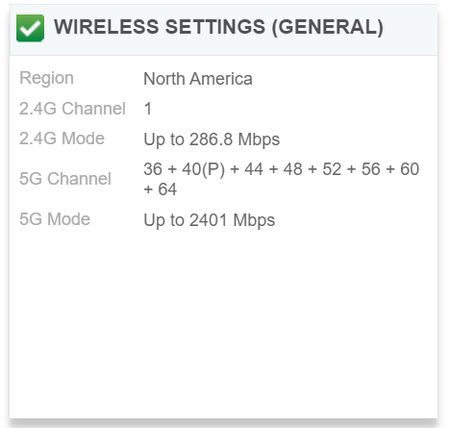
Hi everyone, The 2.4G WiFi of my Orbi RBK762 system is operating at 286.8 Mbps. I have already turned off 20/40 MHz Coexistence and I have also tried other channels. Preamble Mode is set at Autom...

FURRYe38
Jan 11, 2023Guru - Experienced User
Ok, that helps.
Please post the screen capture of the RBS web page now. Edit out the SSID name there before posting.
Is 40Mhz Co-existence only enabled Under Advanced Tab/Advanced Settings/Wireless Settings

CrimpOn
Jan 11, 2023Guru - Experienced User
It has been so long ago that I honestly cannot remember what I set for the 2.4G channel. My memory is "auto" ( as in, "I don't have a preference, pick whatever you want."), but it clearly displays "8" on the WiFi setup page and this displays as 8(P)+4(S), which implies that this router is using 40MHz width for 2.4G.
How did your router get to "1" for the 2.4G channel?
- FURRYe38Jan 11, 2023Guru - Experienced User
Basic Tab/Wireless Settings.
- stuaidJan 11, 2023Tutor
I manually selected 1 after looking at the channel occupancy status using a wifi analyzer tool on my laptop. I have tried using Auto but the router kept selecting channels other than 1, 6, and 11. I thought those were the optimal channels to use for 2.4G? Regardless, even if I use Auto, the max speed is still stuck at 286M. Manually selecting other channels also doesn't help.
- plemansJan 11, 2023Guru - Experienced User
Did you try the newer 6.3.6.4 firmware?
https://www.netgear.com/support/product/RBR760.aspx#download
https://www.netgear.com/support/product/RBs760.aspx#download
- FURRYe38Jan 11, 2023Guru - Experienced User
Good point...something to try and see.
- CrimpOnJan 11, 2023Guru - Experienced User
stuaid wrote:
the router kept selecting channels other than 1, 6, and 11. I thought those were the optimal channels to use for 2.4G? .
When an institution was deploying WiFi 20 years ago, it was a common practice to assign channels to WiFi access points in a "grid" where adjacent access points were on frequencies that did not overlap (1, 6, 11 in the US). There are a number of reasons why this "rule of thumb" is not applicable today:
- Unlike institutions, residential users have no control over adjacent WiFi systems. When I open the network settings on devices, I see 5-6 nearby WiFi systems. (In apartment buildings, there may be a dozen WiFi systems blasting away.) What good does it do me to choose 1,6, or 11 if those channels are being used by neighboring systems?
- Netgear designed the Orbi system to put all access points on the same channel. With 2.4G WiFi having a much larger range than 5G, every time one of the Orbi radios broadcasts on 2.4G, all of the remaining Orbi units (and every user device) must "wait their turn."
- No matter which channel a user selects based on a WiFi survey, if neighbor systems are set to "Auto", they will periodically change channels. If the Orbi was also on "Auto", it could change to (temporarily) avoid them the best it can.
- This practice is based on the original 20MHz wide 2.4G WiFi channels, which have only three channels that do not overlap. A 40MHz bandwidth requires two channels.
That mythical* 600Mbps speed for 2.4G is almost certainly predicated on two factors:
- Use of 40Mhz (two channels)
- Use of 1024QAM encoding (AX) https://www.commscope.com/blog/2018/wi-fi-6-fundamentals-what-is-1024-qam/
* Mythical because (a) that theoretical maximum speed can be achieved only when user device is (literally) only a few feet from the WiFi access point and (b) when the user device is capable of 802.11ax
The speed displayed by the Orbi system is that maximum theoretical speed, so what I cannot explain is why this 760 system is displaying that goofy number (286) and only one channel. I also am fascinated that this 760 appears to be using a 160MHz 5G channel width, which uses channels not typically used in the US.
