NETGEAR is aware of a growing number of phone and online scams. To learn how to stay safe click here.
Forum Discussion

ElDje
Jan 07, 2024Aspirant
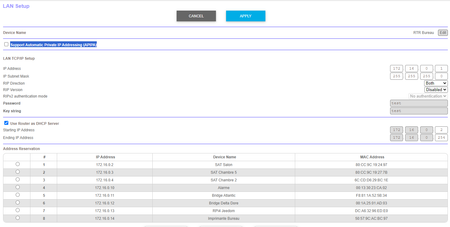
When trying to "apply" changes, get a "400 Bad Request"
Hi,
I have the same issue...
Firmware up to date (V7.2.6.21_5.0.20)
When trying to "apply" changes, get a "400 Bad Request"
When selecting, then deselecting the "Support Automatic Pri...

schumaku
Jan 08, 2024Guru - Experienced User
APIPA == Zero-configuration networking
Microsoft refers to this address autoconfiguration method as Automatic Private IP Addressing (APIPA).
Not sure what this would mean for the Orbi Router NAT implementation - in the eyes of the limited memory space 8-)

CrimpOn
Jan 08, 2024Guru - Experienced User
As FURRYe38 pointed out, the issue is moot since the feature appeared only briefly and is not present in any current Orbi firmware. I was drawn to this option because it was mentioned in the discussion that enabling the feature had an effect on the problem, and I could not find it on my Orbi routers. This led to the question, "What does it mean to support APIPA?"
- APIPA becomes relevant only when devices do not receive responses to DHCP requests and are not set up with static IP addresses.
- Under normal circumstances, Orbi routers act as DHCP servers.
- When Orbi routers are placed in Access Point mode, the upstream router usually acts as the DHCP server.
- Or, users can run their own DHCP server.
- So, what if there is no DHCP server on the network?
In that case, every device creates its own IP address. As long as communication on the LAN is based on using broadcasts, it can be a functional network. "Hey is anyone out there a printer?" "I am. My IP is 169.254.x.x" Use ARP to find the MAC address of that IP and now the device can print. "Are there any media servers?" "Yes, we are at IP...." And so on.
So what part does an Orbi router play in this? Does it create a APIPA LAN address? Is there a way to use IP broadcasts to find an internet gateway? What does it mean to support APIPA?
Guess we'll never know.