NETGEAR is aware of a growing number of phone and online scams. To learn how to stay safe click here.
Forum Discussion

Dan-Wabwile
Nov 15, 2023Aspirant
netgear readynas 316no volume exists. Netgear recommends that you create volume before configuring
Hello , I am getting the error netgear readynas 316 no volume exists. Netgear recommends that you create volume before configuring other settings. I have a readyNAS 316 with 6 disks each 3TB and o...

StephenB
Nov 15, 2023Guru - Experienced User
Dan-Wabwile wrote:
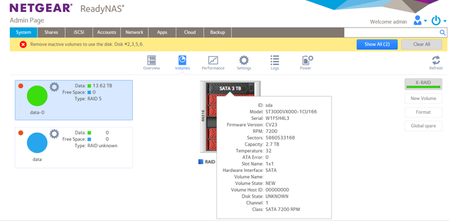
The device is still recognising 13.2 storage. 6 disks by 3tb should be 18TB.
The capacity rule for single redundancy XRAID is "sum the disks and subtract the largest" - in your case that is 15 TB (using 1000*1000*1000*1000 bytes per TB). The remaining 3 TB is used for parity blocks, which allows any single disk to be reconstructed from all of the others.
15 TB is the same as ~ 13.62 TiB (1024*1024*1024*1024 bytes). Which is what your screen shows.
As far as the missing disk 1 and 4 goes, it is difficult to tell what is happening from the screenshot. The best strategy now is to power down the NAS and test the disks in a Windows PC using seatools. Label the disks as you remove them from the NAS, so you can put them back in the correct slots. Don't power up the NAS until all disks are back in place.
I can also take a look at the log zip if you like. If you are interested in that, send me a private message (PM) that includes a download link for the log zip (saving the zip in dropbox, google drive, etc). Make sure the link permissions are set so that anyone with the link can download.
Dan-Wabwile wrote:
How do you go about it in order not to lose data? Does it mean the new disk is faulty?
FWIW, I always test new disks in a PC before putting them into the NAS. I do the full (long) non-destructive read test, and then follow that up with a full erase test. I have had some new disks that pass one of these tests, but fail the other.
As far as replacement goes, I hot swap the disks (removing the old one and inserting the new one with the NAS running).
Still, your data is more vulnerable to loss during a disk replacement than at other times. So I do recommend making sure your backup is up to date before manipulating disks.

Sandshark
Nov 15, 2023Sensei
It sounds likely that the stress of a re-sync caused drive 1 to fail during the sync of the new drive. If it did, then you only have 4 drives of a 6-drive RAID5, and the volume cannot be assembled. There are possible solutions (though most will result in some data loss), so follow the advice of StephenB to determine exactly where you stand so a forward plan can be devised.
If you do have a current backup, then the easiest thing to do is just replace all the bad drives (which may be just drive 1 at this point), restore the data, and mush on.
If you filled your NAS with drives prior to putting it in use, what you are experiencing is all too common because all the drives are the same age and subject to failure in a similar timeframe. That's why I always recommend users start with what they need now and expand later as needed. That spreads out their ages as well as not all being of the same lot (in the event there was a lot issue). The beauty of XRAID is that that's really easy. BTW, I didn't start giving that advice until I came really close to that happening to me. A second drive failed within two weeks of the first, but I was lucky enough that the sync was complete and I just had to replace the drive. At the time, I was backing up to multiple USB devices (the ones I retired in favor of the NAS), so some share backups were not up to date and I would have been very unhappy if I lost the volume. The experience also made me invest in a second NAS (an NV+), which became my primary and I relegated the older one (an Infrant NV) to backup duty.
Related Content
NETGEAR Academy

Boost your skills with the Netgear Academy - Get trained, certified and stay ahead with the latest Netgear technology!
Join Us!
