NETGEAR is aware of a growing number of phone and online scams. To learn how to stay safe click here.
Forum Discussion

Dantech-1
May 05, 2016Tutor
GS728TP which router to use to route data and VOIP
I am looking at buying two GST728TP PoE switches for my sons Garage/Petrol forecourt business. We want one switch in an office in one building and another switch in the shop itself (linked via armoured CAT5 cable underground - cheaper than optic fibre and a run of under 20 metres). Each switch will have a few IP phones connected to them and some PC's. The petrol pumps have IP addresses connected to the cloud, the shop tills and the digital sign on the forecourt showing the prices. These will reside on the default VLAN. We want to create a VOIP VLAN to be used by only the VOIP phones.
I am sure that these switches will route traffic and prioritise traffic for the VOIP phones, but what I need to know is what level of internet router do I need? Does the internet router need to be a layer 3 one or can I just use a router with static routes configured to point to each IP address of the VLAN's configured on the first switch? Obviously the uplink connection between the two switches needs to be configured to allow traffic on each VLAN to pass between the switches. We do not need inter VLAN routing. All we are really trying to do is prioritise the VOIP traffic to get better quality telephone conversations which are not that good when run on a flat VLAN (the default VLAN).
Can anyone recommend the correct Netgear router to buy?
I have done this in a test lab using a Layer3 Cisco switch (2nd Hand off ebay) and my router at home which is TP-Link TD-W9980 VDLS2 Internet router, but configuring the VOIP QoS was a nightmare with none Cisco Phones (we have Siemens Gigaset and Grandstrem IP Phones) and did not work properly with the phones constantly losing registration. I have not used netgear before but these are considerably cheaper than CIsco and they have all the features we need.
Any comments would be gratefully received.
Hi
I have created a document which I am now sharing with the community to hopefully save other people having to go through the problems I had. I am not a Google fan so I have shared a file through my Microsoft One-Drive. Click on the link to read the full document which is illustrated with many screen shots and includes the finally network diagram.
Go to Link to How I setup the VLANs
I could never have done this without the help of netgear support because they pointed me in the right direction but did not do it for me. I have to know how to do it myself so that I can repeat it again. Thanks for the support I have had from Netgear and despite the glitches I mentioned I would definitely use them again, mainly because of the huge price advantage compared to Cisco and HP Switches. However I still think Smart Switches are harder to work with than using a comand line and it takes a lot longer because of having to constantly refresh the webpage!
23 Replies
- mgmtmtTutor
Having a router with static route capability should be enough. According to GST728TP's datasheet, it supports VLAN routing, so you will be able to perform all routing on the switch. However, it does not have a DHCP server, so you might have to create DHCP pools either on the uplink router or a dedicated server.
GS728TP also has a auto VOIP function that does the packet priotization for you.
This KB article has some insights on how to do this:
Depending on the phone you use, you might want check out their POE requirement. On GS728TP only the first 8 ports supports POE+ and rest supports regular POE; it has a 192W total power budget. GS728TPP on the other hand supports POE+ on all 24 ethernet ports; it has a 384W total power budget.
I think GS728TP is a good choice for your use, although if you like to scale your network to a 10G backbone in the future, I would recommend a gs728txp.
 DanthemNETGEAR Employee Retired
FVS336Gv3 is a solid router that should work fine in your setup. It's also VLAN aware and can do QoS. So just set up a voice VLAN and prioritize it throughout the switches and the router.
Hi again. We did buy the two switches as I said earlier but I am still tryiing to get things to work. What I fail to understand is why Netgear have created a Voice VLAN on VLAN 2 and yet the documentation the support person gave me encourages me to create a Voice VLAN! I have done this and made it VLAN 10 and called it VOIP (to have a different name to the VLAN 2 one. I have also changed the Voice VLAN in the relevant page from 2 to 10. We tried it this morning and the VOIP phones did not work, but then tonight I discovered that somehow the switch had lost the route for the phones even though it was there last night. I shall try it again on Thursday this week.
I have noticed that I need to do the latest firmware upgrade because the documentation talk about "Units" and this is not called that on mine.
The documentation seems to imply that all you need to do is plug your phones into the ports and Auto-Voip just prioritises the traffic. It is not that simple. The documentation does not say to set the port as a tagged member of VLAN2, neither does it say you need to remove it as an untagged member of the default VLAN (VLAN 1). It also does not say the PVID needs setting on the port to the VLAN ID of the VOIP VLAN. So I have the phone ports set as tagged onto VLAN 10, the PVID set to 10 and removed the untagged membership of the default VLAN (1).
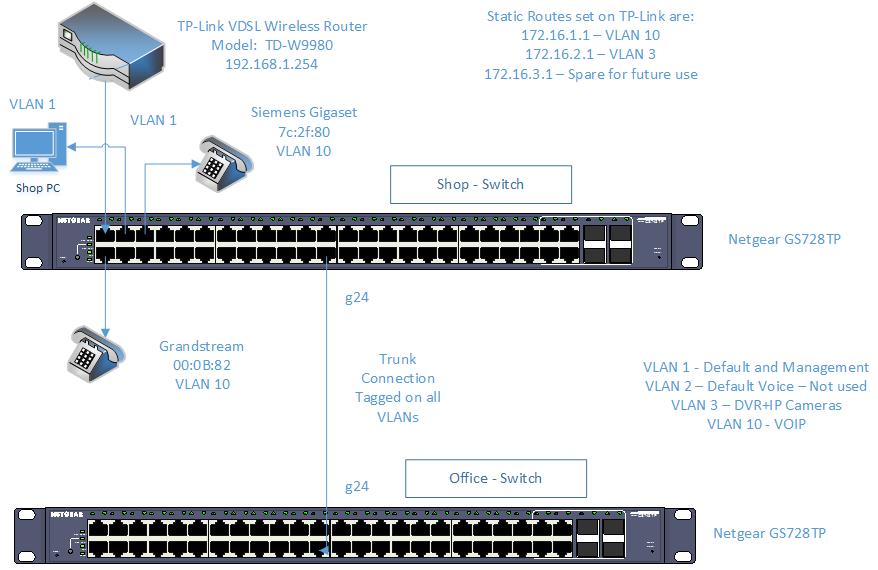
Because the TP-Link router is not a Layer 3 router I am using static routes which I have proved to work at home on mine in a test environment using a cisco switch, but Smart Switches are new to me. It seems. Also the TP-Link is the only DHCP server on the network and so only provides IP addresses in the default 192.168.1.* range. I have configured the VOIP phones with fixed addresses in the 172.16.1.* range. The VLAN 10 ip address has been set to 172.16.1.1 and the static route on the router points to this address.
I need some time to put a client in the VOIP VLAN and check I can ping the phones from both switches. Attached is a diagram of the configuration so far. I welcome any comments on this setup.
Related Content
NETGEAR Academy

Boost your skills with the Netgear Academy - Get trained, certified and stay ahead with the latest Netgear technology!
Join Us!
