NETGEAR is aware of a growing number of phone and online scams. To learn how to stay safe click here.
Installation & Upgrade
629 Topics
Announcing a new project
Hi folks, I'm working on a new readynas related project. Let me start by saying I love these things. I have a bunch of Pro6 and RN516 particularly, but I've worked on lots of different models. I'm passionate about giving them a life, long after Netgear walked away and turned off the lights. The hardware has more to give. I've tried every series alternative OS that I know about. plain linux, TrueNAS, Unraid, OMV and others. They each have something that puts me off. No RAID, No ZFS, noisy fans, no LCD display, having to boot from USB, having to give over one or more precious bays for an OS disk, etc etc. With all the constraints around fixed BIOS (some models) and booting from flash, I want something that still operates a bit like an original Readynas. You turn it on. It boots from flash, starts an OS, and the fans and LCD aren't obviously missing. You dont need a keyboard or BIOS access to get the thing going. So, first, I've been working on creating a 'recipe' or set of instructions for installing plain-jane Debian 13 onto an x64 ReadyNAS box. I manually put GRUB on flash, and then slice my 6 disks thus:- Partition 1 - /boot - 2GB. /dev/md0 RAID1 mirror across 6 disks Partition 2 - swap - 2GB. /dev/md1 RAID10 across 6 disks (so swap = 6GB/more with more bays) Partition 3 - / - 8GB. /dev/md3 RAID10 across 6 disks (so root = 21GB/more with more bays) Partition 4 - rest of disk I then use ZFS to make a storage pool across the 6 disks /dev/sdX4. If you are interested in reviewing the rough notes for how to build a Debian 13 ReadyNAS, I can share them. But beware, blanking your flash is a one-way operation, unless you've taken an image - which is a fairly expert thing to do. All this is working fine. But I wanted the ReadyNAS experience. Quiet fans. LCD display. RAID rebuilds. Drive issue alerts via email. So, second, I started working on something else, a new project called RaidyNAS. A project to put back the missing ReadyNAS features. At the moment, I'm not covering users, shares, protocols etc. For that, I've simply installed OMV on top of Debian 13. But RaidyNAS is what I'm now developing. I'm looking to hear from interested parties who might like to contribute, or to test elements of it. I'm actually doing a bunch of testing from a Debian 13 live boot USB stick, in order to avoid blanking the flash on every single one of my NASs, just yet! So, if you're a bit of an expert with ReadyNAS hardware/OS, and like me, want something future proof, get in touch. If you're a decent coder and want to contribute, get in touch. Basically I'm at the early stages. I have an architecture framework, installer, start-up daemon, alerting, emails, hot plug detection, degrading detection alerts, auto rejoin upon re-presentaton of the same disc, guided partitioning and RAID rejoin for new drives, fan control, and LCD display (part complete). So far this has been tested on Pro6, with some elements in preparation for RN516 also (specific fan profile, LCD display, drive LEDs and front menu buttons). Other RN models can be added. I'm not looking to profit from this. At some point the code will be up on a public repo. So, thoughts, volunteers... go go go. Post below or direct message me. CheersReady NAS 3312: Storage Space is not Showing correct
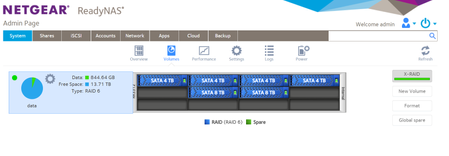
I have installed Ready NAS RS 3312 with storage space as 4TB HDD - 4 Nos. and 8TB HDD - 2 Nos. The system si showing RAID 6 and its showing storage 14.54 TB only. I am not able to figure out the problem behind this. Please help in solving this problem.Announcing a new project..
Hi folks, I'm working on a new readynas related project. Let me start by saying I love these things. I have a bunch of Pro6 and RN516 particularly, but I've worked on lots of different models. I'm passionate about giving them a life, long after Netgear walked away and turned off the lights. The hardware has more to give. I've tried every series alternative OS that I know about. plain linux, TrueNAS, Unraid, OMV and others. They each have something that puts me off. No RAID, No ZFS, noisy fans, no LCD display, having to boot from USB, having to give over one or more precious bays for an OS disk, etc etc. With all the constraints around fixed BIOS (some models) and booting from flash, I want something that still operates a bit like an original Readynas. You turn it on. It boots from flash, starts an OS, and the fans and LCD aren't obviously missing. You dont need a keyboard or BIOS access to get the thing going. So, first, I've been working on creating a 'recipe' or set of instructions for installing plain-jane Debian 13 onto an x64 ReadyNAS box. I manually put GRUB on flash, and then slice my 6 disks thus:- Partition 1 - /boot - 2GB. /dev/md0 RAID1 mirror across 6 disks Partition 2 - swap - 2GB. /dev/md1 RAID10 across 6 disks (so swap = 6GB/more with more bays) Partition 3 - / - 8GB. /dev/md3 RAID10 across 6 disks (so root = 21GB/more with more bays) Partition 4 - rest of disk I then use ZFS to make a storage pool across the 6 disks /dev/sdX4. If you are interested in reviewing the rough notes for how to build a Debian 13 ReadyNAS, I can share them. But beware, blanking your flash is a one-way operation, unless you've taken an image - which is a fairly expert thing to do.Links to instructions for installing TrueNAS with front panel display capability on some ReadyNAS
For those looking to install an alternate OS on their RN42x, 52x, or 62x unit, here is a link to some very good instructions on installing TrueNAS Scale: https://www.reddit.com/r/truenas/comments/1ozklya/truenas_installation_on_readynas_426_a_stepbystep/ Though it's included in that post, here is the link to a project that makes the front display useful in TrueNAS Scale: https://github.com/riplatt/truenas-rn426-panel Given it requires no special Kernel and TrueNAS Scale is Debian based, I suspect that the display project can be used as the basis for doing the same under other Linux OS's (at least Debian-based ones). I take no credit other than finding this and have not done the install myself, so cannot help you if you need it. Personally, I'm looking at OMV.Ready Nas 3312 not showing Internet
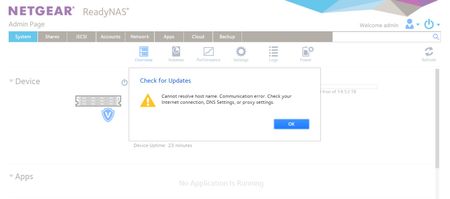
I have installed Ready Nas 3312 and its connected with internet using LAN but its showing error while updating as given below: All other devices conneted with the same switch are getting internet availability. If the same cable connected with ready nas is connected with other devices, the internet is functional. Please help to resolve this issue.
ReadyNAS Pro 6 max RAM
Hi all, Yes, I'm aware the Pro 6 is ancient and I'm aware that many threads here seem to suggest that 8GB is the maximum this box can take. But I'd like to have zfs/TrueNAS on it and I'd love 16GB on it. So I thought I'd ask: is 8GB the actual limit or could it be that it might take 16GB, it's just that nobody ever tried that? It's DDR2 so I'd imagine it might simply be because 8GB DDR2 sticks don't exist? Thanks!Looking for linux-image-extra (6.10.9-10) package
This topic is related and refers to "2.5GBe USB LAN" discussion (https://community.netgear.com/discussions/readynas-general/2-5gbe-usb-lan/2455947/replies/2473823) I have replaced disk drive recently in my NAS, made factory reset default (dont ask why), reflashed good old RNOS 6.10.9 and started over from scratch. Problem which surprisingly appeared is, i cant get, nor find linux-image-extra for my version, or for 6.10.10 (i think file was same and mutual for both versions) = linux-image-extra_4.4.218-610090001_amd64.deb apt get linux-image-extra E: Invalid operation get root@READYNAS:~# apt install linux-image-extra Reading package lists... Done Building dependency tree Reading state information... Done The following NEW packages will be installed: linux-image-extra 0 upgraded, 1 newly installed, 0 to remove and 78 not upgraded. Need to get 6,502 kB of archives. After this operation, 30.7 MB of additional disk space will be used. Err:1 https://apt.readynas.com/packages/readynasos 6.10.9/main amd64 linux-image-extra amd64 4.4.218-610090001 403 Forbidden E: Failed to fetch https://apt.readynas.com/packages/readynasos/dists/6.10.9/main/pool/l/linux/linux-image-extra_4.4.218-610090001_amd64.deb 403 Forbidden I have renewed all the keys (hopefully). I think this is problem of file absence? Not with keys? Because i did all workarounds for apt-get to work, disablind authentification, adding keyrings for debian and freexian (latest, they have deprecated Debian 7 Jessie recently too) and added all the mirros (debian + rnos) Maybe is there some mirror you have, or archive, you made, i am asking just for the file linux-image-extra_4.4.218-610090001_amd64.deb which i cant find anywhere else. Im dumb i havent saved it. I need recompile linux core, and with usb-lan stick driver, just this thing. I hope i cant find help from Netgear, or more probably one of you, who was wise and made mirror or backup of files? Thank you for any helpLooking for feedback on ReadyNAS-Alpine OS
I am curious to know if anyone would provide some feedback on how stable ReadyNAS-Alpine is? Is its current version good enough for use on a primary ReadyNAS device (personal, not business use)? I haven't found any other alternatives to this for an OS upgrade. Have I missed others that exist? Thanks in advanceSolvedRN104: ghost “NG-8TB-Seagate” volume (RAID unknown) Inactive/Unprotected
I have a ReadyNAS RN104 that’s working fine from the data point of view, but the volume configuration seems corrupted and is generating constant volume health alerts that I cannot clear. I’m hoping someone familiar with the ReadyNAS OS 6 config DB can advise on a safe way to remove the ghost volume entries without wiping any data. Hardware / firmware: • Model: RN104 • OS version: 6.10.10 • Disks: • sda: 2 TB (NG-WDRED-2TB-1) • sdb: 6 TB (NG-WDRP-6TB-1) • sdc: 3 TB (NG-WDRED-3TB-2) • sdd: 8 TB (NG-8TB-Seagate) – recently replaced a failed 3 TB Symptom: In the web UI → System → Volumes I see 6 volumes even though I only have 4 disks. The top four are green JBOD volumes with data and look healthy: • NG-8TB-Seagate (JBOD, ~7.27 TB, ~2.64 TB used) • NG-WDRED-3TB-2 (JBOD, ~2.72 TB, ~1.17 TB used) • NG-WDRP-6TB-1 (JBOD, ~5.45 TB, ~4.28 TB used) • NG-WDRED-2TB-1 (JBOD, ~1.81 TB, ~0.2 TB used) Below those, there are two blue entries with 0 data and “RAID unknown”: • NG-WDRED-3TB-1 (0 data, 0 free, RAID unknown) • NG-8TB-Seagate (0 data, 0 free, RAID unknown)