NETGEAR is aware of a growing number of phone and online scams. To learn how to stay safe click here.
Forum Discussion

andykerslake
Feb 06, 2017Star
New Orbi Setup now no disconnects on iPad and other devices
I have just installed a new orbi setup with router and 1 x satellite. I struggled for 2 days trying to work out why some devices iPad 2 and an Android Phone were disconnecting on a very regular b...
Retired_Member
Jun 04, 2017I can almost guarantee that it is a hardware problem causing the backhaul to drop that is causing all of these issues. Some devices handle a brief drop differently than others which is why it appears that nothing happened.
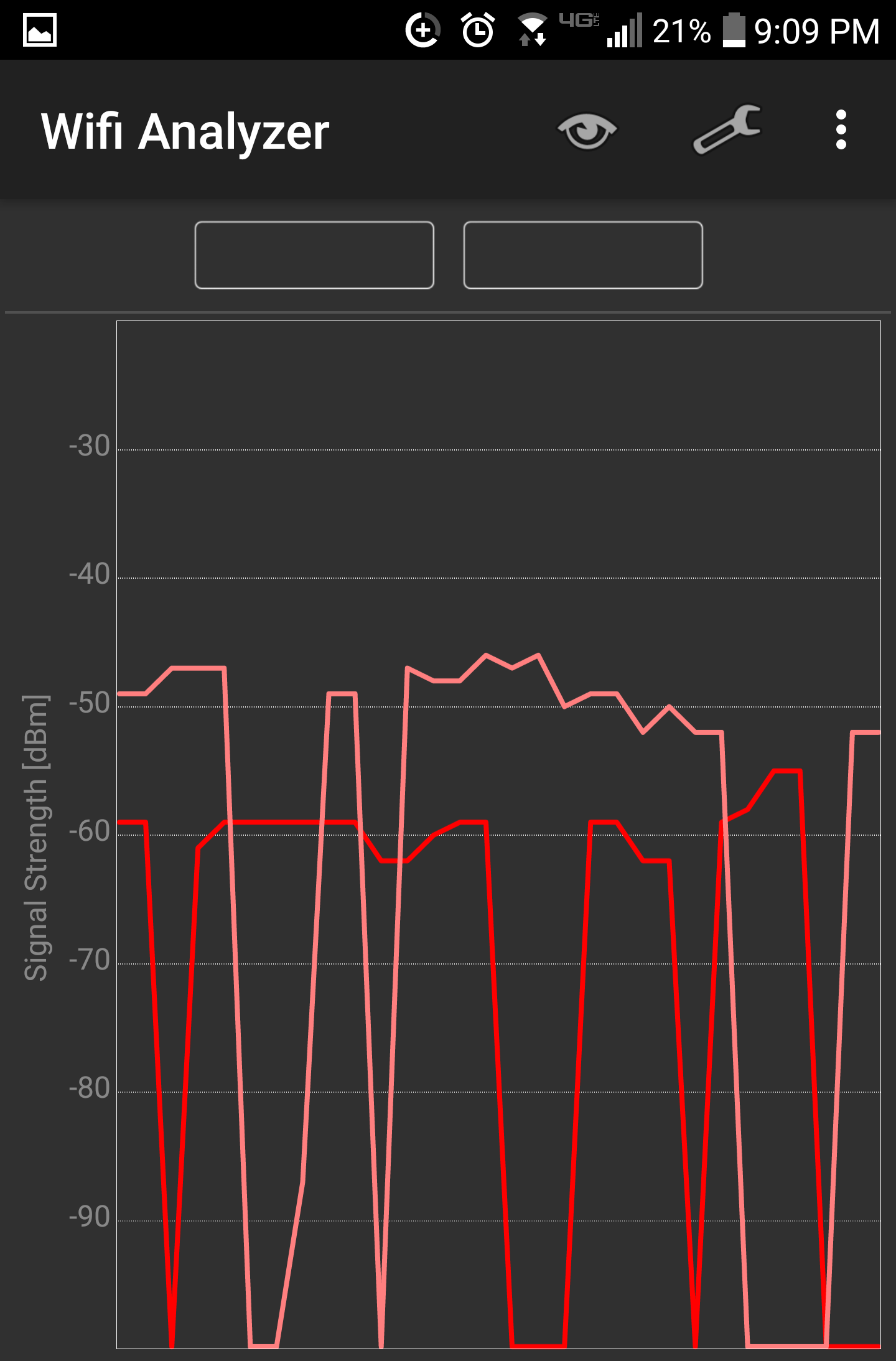
I would recommend you install the Wi-Fi Analyzer app and you can watch your backhaul. There is a 2.4 GHz and a 5 GHz backhaul and they both come from the router. The backhaul will have no SSID. Since the router drops the backhaul, satellite placement doesn't matter.
I really like your troubleshooting process tallackn, they should hire you! Do you have a stable backhaul if you check? Here is my backhaul:
tallackn
Jun 04, 2017Guide
All things considered, except due to a hardware fault or a firmware error, the unit should not be contributing to backhaul failure. Not intermittently anyway.
Going to get really technical now, sorry for those who have trouble following.
Let's assume that the backhaul is a standard WDS link, with the router being the root and the satellite being the client. Let's also assume the total power budget of the link to remain the same (no change in obsticals or antennas), and let's also assume a minimum SNR of 20dB.
So, the WDS operates at a symbol rate that is optimised for the RSSI, nice and stable, well established. It may indeed get some additional spatial streams up at reasonable symbol rates, but for the sake of troubleshooting let's assume it stays on a single stream.
So now you have an established link, at least 20dB above the noise floor required for the symbol rate and no changes in physical environment. Why would the link fail?
There is a small chance that there is noice introduced, and considering we are likely operating on an 80MHz wide channel using omidirectional antennas that is quite likely. But even if such a thing happened the unit would drop the symbol rate to bring the RSSI back to the minimum reliable level and/or narrow the channel width so that it could move away from the noise (assuming the noise is not right across the UNII-3 band), thus maintaining the link.
If we were operating right at the edge of our coverage area that might not be possible, so that could be the cause of the link failing.
If the hardware were fauly it is unlikely it would be faulty in a way that would result in intermittent failures. And if the firmware were faulty we'd see a whole lot more people experiencing this problem.
There are other more sinister causes of course. You could have someone spoofing disassociation frames, but I believe there is management frame protection enabled by default on the backhaul radio (maybe even client radios). And any kind of RF denial of service would manifest for the endpoints associated to the router unit as well as the backhaul.
I'd rule out the range possiblity probelm first. Alot of people place their units right at the edge of their coverage areas leaving little room for the radios to adapt to changing RF conditions.
My units are placed about 20m apart with about 8dB of loss from internal walls, so I am getting a great experience (backhaul datarate seems to be around 400Mbps of client payload plus management overhead) and am quite confident that there is plenty of margin to work with for RF problems. Placement is 90% of the key to success. :)