ReadyNAS OS 6 on Legacy models
1027 Topics
no update on RN 3312
Hi all, I have a very old RN 3312 and can´t perform update (Error: "Hostname can´t resolved ..."). When I connect via SSH I could find ou, that connection to internet works fine (ping to several public servers in www). I could not understand this. Why doesn´t update works while internet is reachable? Thanks for your help Reinhard63Views0likes1CommentRN212 can't seen by time machine anymore
Dear forum experts, my RN 212 vers. 6.10.10 run flawless for a long time... Raidar vers. 6.5.0 can still see the NAS and tell me everything OK, aka two green light for the two 4TB disc bays. RN 212 system overview show, 3.02 TB free on disc and of coarse is set to use SMB. macOS Monterey 12.7.6, TimeMachine should backup an internal SSD with 2TB Now it reports "Communication error, check DNS and Proxy settings" The only thing i had changed recently, is a new mesh 7 Wifi, for the house. But the RN212 is connected to the Mac by wired LAN, thus a mesh Wifi shouldn't affect the LAN settings? Any ideas from forum users welcomed BTW: When logging in i was forced to set a new pw, afterwards i've been told all usernames including my old one (Bob) are used and i have to create a new one. But every name i keyed in, was already taken, thus i endet with this stupid one...sorry374Views0likes15CommentsRN104 data-0 inactive since April, still stuck after PSU fix - need assemble advice
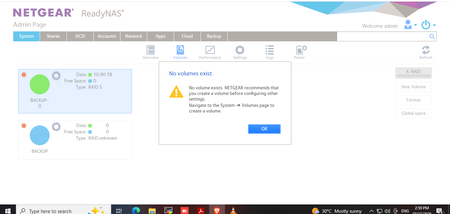
Hi all, I have a ReadyNAS 104 (firmware 6.10.10) with a 4-bay X-RAID2 setup: two Seagate IronWolf 4TB drives and two WD Red 3TB drives. The 3TB baseline across all four disks forms a RAID5 volume called data-0 (8.17 TB), and the extra capacity on the two 4TB drives forms a separate RAID1 volume (931 GB). What happened, as best I can reconstruct from the logs: On April 27, 2026 at 11:01 AM, the system log shows "Disk in channel 4 (Internal) changed state from ONLINE to FAILED." That drive is one of the two WD Reds. SMART data shows a burst of about 878 read errors on that drive's data-0 partition earlier that same morning, right at the tail end of the partition. No reallocated, pending, or uncorrectable sectors before, during, or since, on any drive. - Alert emails have apparently never worked on this box ("Alert message failed to send" recurs in the logs going back to 2016), so nobody knew about the April failure. The volume was presumably running degraded on 3 of 4 drives from that point on. - On September 13, 2026, the external power adapter started failing, causing all four drives to drop and reconnect erratically, which pushed the NAS into booting its factory-default recovery image. - I replaced the power adapter (correct NU90-9120700-I2, 12V/7A). The NAS now boots its normal OS again, all four physical drives are detected correctly, and a separate small mirror volume auto-repaired and finished resyncing on its own. - data-0, the 8.17 TB volume with almost all my data, has never been auto-assembled by mdadm across two separate boots since the PSU was fixed, even though the smaller pools repair themselves automatically. The admin page shows "Remove inactive volumes to use the disk. Disk #3,4." What I've verified so far: All four drives pass SMART self-tests clean, zero reallocated, pending, or uncorrectable sectors. - I have not clicked "Remove inactive volumes," Format, New Volume, or X-RAID anywhere. - SSH itself fails to start on this box right now (error code 15002030001, and "Connection refused" on an actual attempt). - I have full log bundles from before and after the PSU replacement if useful. What I'm hoping for: I found a very similar solved thread here on this forum (RN104, disk kicked as non-fresh after a power problem, fixed via tech support mode and mdadm --assemble --really-force --readonly). Before I touch anything, I'd appreciate help confirming whether that's the right first step for my logs, and the correct device list for my array specifically. Since SSH won't start, I understand the path in is tech support mode via the boot menu and Telnet, unless there's a better route. Thanks so much in advance. Link to that similar solved thread: https://community.netgear.com/discussions/readynas-use/readynas-104---cannot-access-data---remove-inactive-volumes-to-use-the-disk/2454089184Views0likes16CommentsReadyNAS 316 Volume set Inactive
Hello, I have a readynas 316 running firmware 6.10.9. I keep it on this firmware just so I can run Plex on it. We were moving some stuff and bumped into the shelf the nas lives on. The shelf leaned a bit and two of the drives slid out from their bays. The volume set switch to dead. I powered down the NAS and then placed the drives back in their bays and booted the NAS back up. I can see the drives online, but the volume is labeled as inactive. Is my data gone or is there some hope of recovery?76Views0likes1Commenterror with rsyn 7077010012
Dear community, I am reaying to setup with my readnas102 a remote connection to server to backup, using the remote rsync but I get teh error above, and as I run a test with putty to connect to server it works fine, it is just form the nas I am not being able to connect, any suggestions?199Views0likes7CommentsVPD for RNDP6000-200
I have a ReadyNAS Pro 6 (ReadyNAS RNDP6000-200) whose VPD was destroyed during a USB recovery. I have pre-damage logs confirming it is loader: RNDP6000-V2. The NAS is now booting OS 6.10.10 but reports no valid model/serial and keeps looping into setup mode. Could anyone help me with a copy of the VPD from one of their working Pro 6 / RNDP6000-V2 systems? I understand it will contain the donor serial number and that I will use it at my own risk. I only need the encrypted file named vpd from the boot flash. Here are some of the pertinent details from an old log file that may be helpful: ReadyNAS Pro 6 FLAME6-MB V2.0 hardware vendor: NETGEAR model: ReadyNAS Pro 6 model_valid: 1 version: 1 loader: RNDP6000-V2 max_chan: 6 xraid: 1 pcbid: 1 board_rev: 0001 system_rev: 0003140Views0likes4CommentsReadyNAS Pro 6 Business Edition RNDP6000 Booy Issue.
Apologies as I know this unit is not supported at all these days but has served me well so wanted to try and get this working again. OS 6 6.10.9 was installed (my initial OS 6 upgrade with the help of an excellent Tech support person a few years ago) and has updates and run flawlessly since. I recently tried a snapshot restore to go to some older files and the system hung/crashed. I couldn't access web Gui, so tried an OS reinstall and then all worked fine. Disks were doing a resync and all finished ok. Next morning the system was powered up but was powered up but hung with no PING or access at all. I have rigged up a Monitor, Keyboard and mouse and created a USB recovery key created. Thought I would try to update to ReadyNASOS-6.10.10-x86_64 via USB: 1. Insert USB in front USB port. 2. Rebooted with backup button pressed - BIOS loads and syslinux loads but just then monitor screen goes blank and the LCD screen stays on "ReadyNAS" I've tried pressing the reset or pressing the backup button to see if the options scroll but not go. Am I missing something here or should this boot into the USB? I'd like to get working even just to access/backup the current shares if possible, so don't want to go the factory reset if possible. Any advice would be appreciated. Many thanksSolved470Views0likes21CommentsReadyNAS 104 RAID5: 'Remove inactive volumes' after crash during resync - recovery needed
Hi all, I have a ReadyNAS RN104, firmware 6.10.8, with 4x WD Red 3TB (WD30EFRX) in RAID5 (X-RAID). I'm hoping for guidance on safely reactivating my volume without losing data - I do NOT want to guess or experiment further, since I already know that's risky. SETUP / TIMELINE - Disk in bay 3 was reported FAILED (confirmed via admin panel, matching blinking LED, and SMART data showing high ATA error count / pending sectors, while bays 1, 2, 4 were clean or only minor). - I bought an identical replacement WD30EFRX and did a partial backup (docs, photos, music) to an external USB drive before touching anything. - After disconnecting the external drive, the system automatically started a resync on the degraded volume. - ~18 minutes later, per the system log: another disk (Channel 2, log-based indexing) went from ONLINE to FAILED during the resync, the resync target disk (Channel 3) went from RESYNC back to ONLINE, and the volume health changed from Degraded to Dead. The system then warned it would auto-shutdown in 30 minutes. - I shut the system down manually and physically replaced the old failed disk in bay 3 with the new one. - On power-up, I got: "Remove inactive volumes to use the disk. Disk #1,2,4." and the Volumes page shows two entries: "data-0" (8.17TB data, RAID5, red status) and a second "data" volume (0 data, "RAID unknown", red status). CURRENT STATE (from volume.log dump) - RAID data-0: Level 5, State: inactive, Members: 4, but only 3 disks currently listed under it: sdd (bay1), sdc (bay2), sda (bay4) - all three show no Reallocated Sectors, no Uncorrectable Sectors; sdc has Current Pending Sector Count: 2, others 0. - The "data" pool (the second, empty one) has a null UUID (000...000), Type: btrfs, 0 disks assigned - looks like a stale/ghost volume reference, not a real data container. - Maintenance history log shows two earlier resilver operations (2026-07-11 and 2026-07-25) that both completed but left the pool "degraded", and a third resilver started 2026-07-27 that has no end_time/result - this is the one that was interrupted by the crash described above. - New disk in bay 3: brand new, 0 power-on hours, not yet part of any pool (no Pool: line in its log entry) - as expected, it hasn't rejoined the array yet. WHAT I'M ASKING Based on what I've read about ReadyNAS event-count mismatches after an unclean shutdown/crash during resync, this looks like it could be a recoverable case (3 consistent disks, no reallocated/uncorrectable sectors) rather than a true double-disk failure - but I don't want to force-assemble anything myself without being sure of the exact commands/parameters for my array, since I've read that experimenting further can easily make things worse. Netgear won't open an official support case since the RN104 is out of support. I do NOT have a complete backup (only partial, done just before the crash), so I'd really appreciate guidance from someone experienced with forcing a safe mdadm/BTRFS re-assembly on ReadyNAS OS6, or confirmation on what "Remove inactive volumes" actually does in this specific situation before I click anything. I have the full log zip ready and I'm happy to share it privately (PM) with anyone willing to take a look - didn't want to post it publicly here. Thanks in advance for any help.67Views0likes1Comment