NETGEAR is aware of a growing number of phone and online scams. To learn how to stay safe click here.
Troubleshooting
441 TopicsGS308EP sends management traffic outside configured Management VLAN
Hello, I would like to report a possible VLAN isolation issue with my GS308EP. Environment Device: NETGEAR GS308EP Firmware: V2.0.0.11 (latest as of writing) Configuration: The uplink port is configured as an IEEE 802.1Q trunk. Management VLAN is configured as VLAN 8. Management IP address is 192.168.8.18. The uplink is connected to a Linux router with multiple 802.1Q VLAN interfaces. The VLAN interfaces share the physical NIC's MAC address, which is the default behavior of Linux VLAN interfaces. The router also has arp_ignore=1 and arp_announce=2 configured to prevent ARP flux-related issues. Observed behavior Although the management VLAN is configured as VLAN 8, the GS308EP sends management-related traffic on VLANs other than VLAN 8. For example, packet captures show the switch sending ARP requests on multiple VLANs: VLAN 19: ARP Request: who-has 192.168.8.1 tell 192.168.8.18 Sender MAC: 28:94:01:XX:XX:XX The same ARP request appears to be sent on the VLANs configured on the GS308EP, in ascending VLAN ID order. In addition, management traffic generated by the switch, such as NTP, DNS, and UPnP/SSDP traffic, is observed on non-management VLANs. Expected behavior I would expect: - Management traffic generated by the GS308EP to be sent only through the configured Management VLAN. - ARP, NTP, DNS, UPnP/SSDP, and other management-plane traffic to use VLAN 8 only. - No traffic sourced from the management IP address (192.168.8.18) to appear on other VLANs. I can provide packet captures if needed. Thank you.225Views2likes12Comments
GS116EP and Cisco Switch Trunk Issue
I need to pass multiple VLANS between a Cisco C9300 switch and a GS116EP. I've tried two brand new GS116EP switches, so it has to be an issue with the config. C9300 interface config: switchport trunk allowed vlan 1,10,20,30,40,50 switchport mode trunk switchport nonegotiate GS116EP config: port 1 is connected to the C9300 vlan 1 is untagged (C9300 native vlan ID) vlans 10,20,30,40,50 are tagged PVID is set to 1 The latest firmware version (2.0.0.5) has been installed. If I set corresponding C9300 interface to access mode, there's no issues. Trunking is the issue. What am I missing? Thank you for the help on this!GS308e Admin page unreachable
I am having an issue where I can't access the Admin page for GS308e switch. I have ATT Fiber modem/router. I have the modem/router connected to the switch and multiple LAN connections off the switch. In my office, I have a Netgear nighthawk operating as a WAP. I cannot access through the Insight App nor the Switch Discovery Tool. I've tried resetting to default and I am still having same issues. I need help. Thanks,GS305E Setup VLAN's from behind the switch
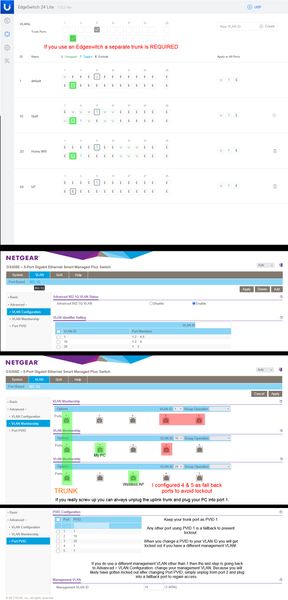
The PC used to configure the switch permanently resides downstream of the switch, on a VLAN, and MGMT VLAN that is not 1. It becomes a chicken & egg problem where you will be constantly locked out and forced to reset the switch as you try all the different combinations. I tried googling for solutions and the closest was the topic GS305E Trunking tagged and untagged VLAN's. It was very helpful. However my issue is slightly different and I wanted to share what worked. It was... a process. Step 1: Configure your upstream switch with a trunked port for all the VLAN's you intend to have traffic through the GS305E switch. In the case of a Ubiquiti EdgeSwitch 24 for example, it absolutely 100% requires a new trunked port... even though you already likely have a main trunk tagged and setup for VLAN's. Step 2: Manually configure your PC's IP address to be in the 192.168.0.x subnet. Plug your PC into any port on the switch. Which port you choose to plug into does not matter for initial configuration, they are all configured identically. Use a browser and go to 192.168.0.139 and login with the password: password. There is no username so this switch is not appropriate for a multi-admin environment. Step 3: Change your password. This is mandatory and you will be presented with a screen to do so immediately upon first successful login. Step 4: You will immediately see the main system settings page (home). Disable DHCP mode and provide the device with a static IP within the subnet range where it will permanently reside. Also provide the subnet gateway IP (Subnet DHCP server). Apply the changes, no reboot necessary, the browser will timeout because the switch will now be found at that new static IP. You will likely want to change your PC's IP again to be within the new subnet range. Step 5: Go to VLAN > 801.q > Advanced: and enable the advanced option. Step 6: Advanced > VLAN Configuration: add your VLANs. You cannot remove VLAN 1 it is hardcoded and also used as the management VLAN by default. DO NOT attempt to change the management VLAN yet if your management VLAN is not 1. You will do that at the very end almost as the last step. This is why a lot of people (meeeee) have locked up their GS305E during initial configuration by changing that too soon, don't do that, don't touch it, live with management VLAN as 1 until you have everything working. Step 7: Advanced > VLAN Membership: this is where you setup your trunked port and tags. Now is when you decide which port you want to be the trunk port. I use port 1 but port 5 is also a logical choice. Whatever port you decide to make the trunk the default VLAN 1 should be untagged and the rest of your VLAN's under it tagged. Step 8: Advanced > Port PVID: the trunk port should always remain as PVID 1. Change the PVID's to your VLAN ID's. A note of caution if you have a different management VLAN than 1. This will lock you out and force you to plug into a fall back port. If your management VLAN is 1 then you should be finished. Step 9: Advanced > VLAN Configuration: If you need to change your management VLAN now is the time, the last final step. If you would have attempted to change your management VLAN at any time during the prior processes you would have been locked out and likely forced to hardware reset the switch to defaults. This is what worked for me. I spent about a day trying to get it all to work and honestly I believe the one thing that prevented me from succeeding most of the time was not setting up that port as a trunk port on the Edgeswitch. It shouldn't be needed like that but it definitely does not work if that trunk checkbox isn't checked. All feedback, corrections, comments, will be gladly accepted. Just please try to keep them constructive.GS110EMX: 10G ports throttle uploads to 250-300 Mbps
I've been going back and forth with Netgear support for over a week about this and I'm honestly at a loss. I'm hoping someone here can tell me if I'm crazy or if what they're telling me doesn't make sense, because it really doesn't add up to me. My Setup Switch: Netgear GS110EMX (firmware 1.0.2.8) Port 1: Internet uplink (1G, connected to router — standard fiber ISP) Port 9: Mac Pro via OWC Thunderbolt 4 to 10G Ethernet Adapter Port 10: Asustor AS6508T NAS (10G) Cables: Cat6A throughout This is exactly why I bought this switch — two 10G ports for my computer and NAS, with everything else on the 1G ports. Pretty standard home prosumer setup. The Problem Internet uploads are throttled to about 250-300 Mbps when my computer is on a 10G port. Downloads are fine at 830-880 Mbps. When I move the same computer to a 1G port with the exact same cable, uploads jump to 708 Mbps. That's more than double the speed on a port that's supposedly 10x slower. What I've Tested (at Netgear's request) I ran every test their L3 support team asked for. Here are the results: Internet Speed Tests (computer on 10G port 9): Flow Control Download Upload OFF 865 Mbps 306 Mbps ON (port 9 only) 879 Mbps 169 Mbps ON (both 9 & 10) 820 Mbps 137 Mbps Internet Speed Test — computer on 1G port (same cable, same everything): Download Upload 884 Mbps 708 Mbps iPerf3 between Mac and NAS (local, 10G ↔ 10G): Direction Speed Mac → NAS 3.73 Gbps NAS → Mac 9.40 Gbps Local 10G performance is excellent. The ports, cables, and NIC all work fine. What Netgear Says After all this testing, support came back and told me: This is "working as expected" and "within the design limitations of the switch" The 10G ports are "intended to be used as uplinks" — not for client devices A replacement would behave the same way My configuration is "not the intended use case" Why I'm Confused I don't understand how any of this is "expected behavior." Specifically: How does a 1G port give me faster uploads than a 10G port? If the 1G uplink is the bottleneck, moving to a slower port should give me equal or worse speeds. Not more than double. Nobody has explained this. Why are only uploads affected? Downloads through the 10G port hit 865 Mbps — nearly saturating the 1G uplink. The traffic crosses the same 10G/1G speed boundary in both directions. Why would only one direction have "buffer overflow" problems? Flow Control made things WORSE. They asked me to enable it. It dropped uploads from 306 Mbps to 137 Mbps. How is that a fix? The product page says "No Network Bottlenecks thanks to the 2 10-Gigabit/Multi-Gigabit Uplinks." Now support says those ports are only meant to be uplinks and my setup is unsupported. The user manual literally shows 10G client devices connected to ports 9 and 10 in its network diagrams. This switch used to work. I used the exact same setup with fiber in Chicago for years with no issues. I only noticed the problem after switching to fiber here in LA recently. Something changed. What I'm Asking Has anyone else seen this? Am I wrong to think a managed switch should be able to handle 10G devices sending traffic through a 1G uplink without losing 70% of the uplink's capacity? I've seen a couple other threads about similar issues with the GS110EMX and I'm starting to think this is a known design flaw that Netgear just doesn't want to acknowledge. At this point I just want to know if I should keep fighting for a replacement or just give up and buy a different switch. Any insight would be really appreciated. I've spent way too many hours on this already.GS752TPV3 "comcast uplink port"
Howdy All, We have instrumented our first "new to us" Netgear switch for our classroom (to replace like 7 smaller switched that were scattered around) and I got it up and running, but realize that PORT 7 is the "uplink to our comcast router" port and now we're putting a new classroom computer onto that port, so I need to move the uplink line. I tried changing the VLAN to include Port 48 and Port 39 (both free in our schema) and moved the network line, but the switch refused to route traffic. I rebooted the switch (not reset, restart) to see if "coming up on the new line" would work, but no. If I move the line back to port 7 (still in the VLAN) it resumes functionality. I have checked the port configurations in the switch web admin, and they are identical. I have checked the VLAN membership configuration, and all three ports are "U"ntagged, with the same attributes. Any ideas? Thanks in advanceHelp: Auto-VoIP setting to correct VLAN, but also incorrectly on default
We are trying to configure our S3300's to utilize Auto-VoIP. The goal being that all devices with the correct MAC prefix will be pushed onto the VoIP VLAN regardless of device settings, and without having to manually adjust VLAN assignments on our switches. We have the default VLAN for normal network traffic (PCs, printers, etc), and have Auto-VoIP set up on VLAN 88. We've added several MAC prefixes for our phones. We have our FortiGate firewall configured with two LAN segments. The first for PCs, and the second for VoIP. Both of them are set to the default VLAN ID. The FortiGate subnet used for VoIP has its MAC address set to match a Poly prefix. When it is plugged into a Netgear S3300 switch, it shows up on both VLAN 88 and VLAN 1. It should only be on VLAN 88. Since the Fortigate is configured to do DHCP duty on the VoIP LANs, this is a problem: a non-VoIP device will pull an IP address from the VoIP LAN. The MAC address 80:5E:C0:09:00:05 should only be on VLAN 88. Since it's also showing up on VLAN 1, when I plug a laptop into the switch, it will pull DHCP for the VoIP network. That needs to not happen. Any idea what we're doing wrong? Any help greatly appreciated!